Fee logic
The guarantors fee cannot work the same way in every deal
Why does the guarantors fee change from one deal to another? Some deals move almost without friction. For example, a small account transfer can take only a few checks:
- the seller gives access,
- the buyer logs in,
- the buyer checks the recovery email,
- the buyer checks 2FA and confirms the result.
In that case, both sides usually understand when Garant-Pro can release the funds. However, many online deals create more pressure. A Telegram channel, a software license, a game account, a document package, a database, a design layout, or website work can all hide different points of risk.
For example, the seller may already think the work is complete. Meanwhile, the buyer may still wait for final files, admin rights, email access, source files, or a result that they can actually use.
Many disputes do not start with clear fraud. Instead, they start because both sides understood the fee, the deadline, or the delivery conditions differently.
One common phrase appears again and again: “I thought the fee was already included.” This short sentence can turn a normal deal into an argument. Therefore, the deal screen must show who pays the fee and how much the service retains before both sides confirm the deal.
Calculation
How Garant-Pro calculates the fee by deal type
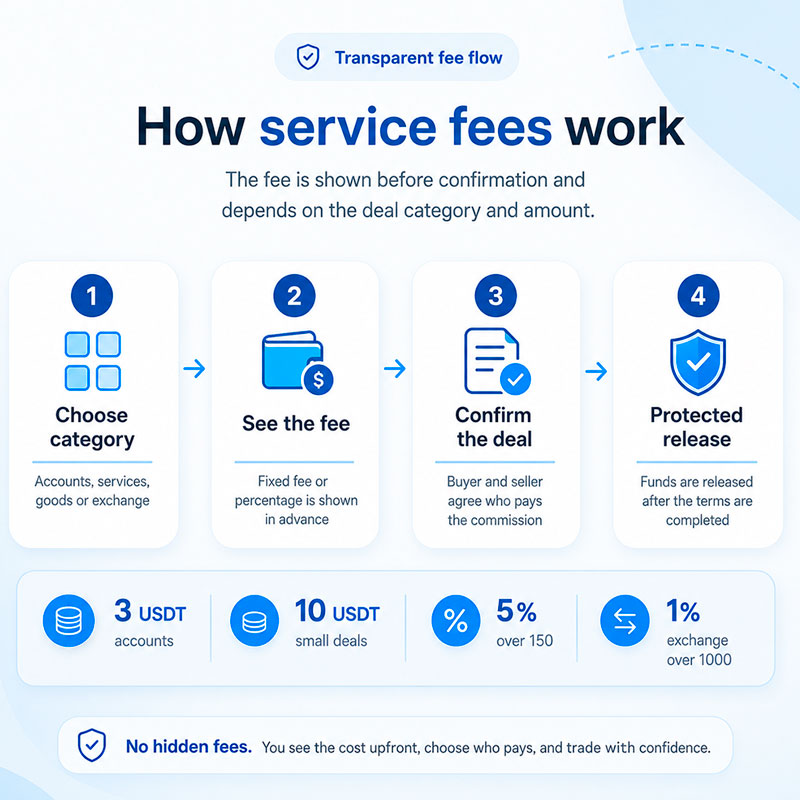
Garant-Pro calculates the guarantor service cost by deal category and amount. For accounts and verification tasks, the service uses a basic fixed fee for smaller deals and a percentage for larger ones, as shown in the table below. This keeps simple transfers predictable and stops the service cost from becoming heavier than the deal itself.
Remember that this covers only the Garant-Pro service fee. Payment systems, blockchain networks, exchanges, banks, or providers may add their own charges separately.
For goods, services, information products, development, design, and document deals, the fee also depends on the amount. As the value grows, the deal usually stops looking like a quick exchange. Instead, both sides need to manage more details:
- deadlines,
- result checks,
- handover details,
- possible disagreement over what the seller actually delivered.
Because of that, larger deals require more attention before Garant-Pro can release funds safely.
Game accounts and game items use a percentage model with a minimum fee. Currency exchange uses a separate scale. A large exchange creates different pressure than a small account sale, because both sides usually care more about confirmations, timing, and possible loss.
On smaller deals, users often focus on the fee because they see it clearly in the final amount. On larger deals, however, the main question changes: did both sides write the release conditions clearly enough?
Commission table
Guarantor service cost for online deals
Most users open this section for a quick number. If you already know the deal category and amount, the table helps you estimate the service cost before you create a deal. You can also use the commission calculator. The side named in the deal terms pays the commission.
Garant-Pro does not include blockchain network fees, exchange charges, bank commissions, or payment provider costs in its service fee unless the deal screen says otherwise.
| Category |
Fee |
Condition |
Note |
| Accounts, verification |
3 USDT |
Up to 100 USDT |
Fixed fee |
| 3% |
From 100 USDT |
From the deal amount |
| Goods, services |
10 USDT |
Up to 200 USDT |
Fixed fee |
| 5% |
From 200 USDT |
From the deal amount |
| Information, manuals |
10 USDT |
Up to 200 USDT |
Databases, manuals, training, access, and instructions |
| 5% |
From 200 USDT |
From the deal amount |
| Security deposit |
10 USDT |
Up to 200 USDT |
Fixed fee |
| 3% |
From 200 USDT |
From the deposit amount |
| Development, programming |
10 USDT |
Up to 200 USDT |
Fixed fee |
| 5% |
From 200 USDT |
From the deal amount |
| Design |
10 USDT |
Up to 200 USDT |
Design, illustrations, and layouts |
| 5% |
From 200 USDT |
From the deal amount |
| Documents |
10 USDT |
Up to 200 USDT |
Templates, contracts, and other documents |
| 5% |
From 200 USDT |
From the deal amount |
| Game accounts, items |
3% |
Any amount |
Minimum 5 USDT |
| Currency exchange |
5 USDT |
Up to 1,000 USDT |
Fixed fee |
| 1% |
Over 1,000 USDT |
From the exchange amount |
Before deal confirmation
Where Garant-Pro shows the fee before confirmation
Garant-Pro shows the fee inside the deal flow before final confirmation. It should not appear later in a private chat after the buyer has already paid or after the seller has already transferred part of the access or materials.
This matters most in fast Telegram negotiations. One person sends a link, the second person agrees, and someone writes the price in a short message. Then, only later, both sides realize they discussed different final amounts. Therefore, the deal screen should remove that uncertainty before payment.
Commission questions usually take less time than delivery disputes. In most cases, one question causes the problem: who was supposed to pay? When both sides record that rule in advance, they finish the deal with less friction.
Who pays the fee in safer online deals
The buyer can pay the fee when the main risk is receiving a promise instead of a result. This often happens when someone buys a social media account, service access, a paid manual, a design file, or a document package.
The seller can also pay the fee. For example, an account seller may cover the commission because the guarantor process makes the offer more credible and helps the buyer start without paying on trust.
Both sides can split the fee as well. This works when both participants benefit from the protection and neither side wants the commission to turn into a separate negotiation.
A typical example is a social media account sale. The buyer needs login credentials, email access, and recovery details. At the same time, the seller needs to know that the buyer has already reserved the payment and cannot hold it back without a reason. The fee covers the controlled release process between these two risks.
Terminology
Why similar fee searches can describe different services
Search terms can create confusion. People may look for the guarantors fee, guarantor service cost, insurent cost, insurent guarantor fee, insurent fee, or insurent guarantor cost and expect one pricing model.
However, these phrases can describe different services. A rental guarantor, a tenant-checking service, and a guarantor service for online deals do not solve the same problem. They work with different risks, different conditions, and different fee models.
So, compare the cost by the transaction itself, not by the word “guarantor.” Look at what the parties transfer, how much the deal is worth, who confirms completion, and when the recipient gets the funds. Without those details, two similar-looking fees may belong to completely different services.
At Garant-Pro, the guarantor service cost follows the deal category and amount. As a result, both sides can see what they pay for in advance: not a vague promise that “everything will be safe,” but a structured process where terms, deposit, verification, and fund release stay tied to one specific deal.
Ready to check a deal?
Open the bot when the category, amount and release condition are already clear enough to show to the second party.
Create a deal
FAQ
Questions users ask
Is the fee paid before the deal starts?
The amount should be visible before confirmation. In a manual or MVP flow, support may still check details, but the user should not discover the commission after the transfer.
Can the commission be split?
Yes. Buyer and seller can split it if that is what they agreed. The important part is to write it into the deal terms before the second party accepts.
Are network fees included?
Usually no. Blockchain network fees, exchange charges, bank commissions and payment provider costs can appear separately. They are not the same as the Garant-Pro service commission.
Why are larger deals charged differently?
A larger deal usually takes more attention: payment confirmation, timing, evidence, release conditions and sometimes a dispute review. The fee reflects that extra responsibility.